Buying an underground storage tank is not like buying most equipment. You will place a six-figure order on a product you probably will not see before it arrives, from a supplier you found through a search, on a schedule that determines when your site can start selling fuel. Then it goes in the ground, where fixing a bad decision costs many times what the tank did.
So the supplier matters more than the specification, which is broadly standardized. Here is what actually separates them, in the order it matters.
1. Is the tank real, or is it a production slot?
This is the single most important question and the one most often answered ambiguously. “We can have that for you” and “we have that” are completely different statements, and the gap between them is currently four to six months across much of the industry.
Ways to make the answer unambiguous:
- “Is this unit built and on the ground today?” Not “available” — built.
- “Where is it physically?” A supplier holding stock can name the yard.
- “Can I come and see it?” If a tank exists, this is an easy yes. Very few buyers actually make the trip, but the willingness to host it tells you what you need to know.
- “What is the date, and what is it contingent on?” A real delivery date depends on a truck and a crane. A soft one depends on a mill schedule you cannot see.
Our own inventory counts are published on the inventory page and they are live. That is a deliberate choice, and you should hold any supplier to the same standard.
2. Delivered price, not FOB
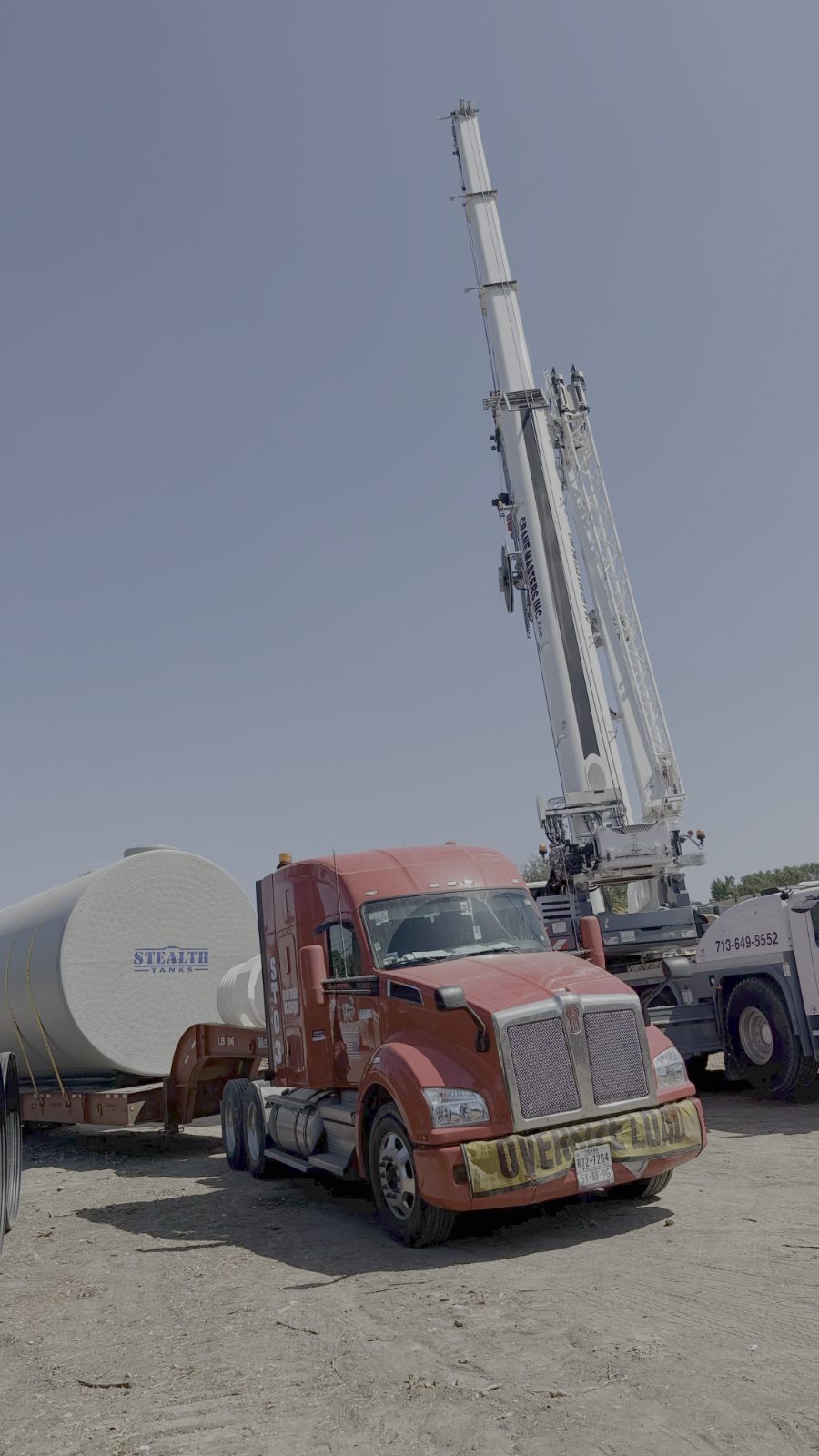
A large UST is an oversize load. It travels on a specialized trailer, frequently with permits and sometimes with escorts. That cost is real and it varies enormously with distance.
A quote priced FOB the supplier's plant leaves that number out entirely, which makes two quotes look comparable when they are not. Worse, out-of-state freight is often exposed to a fuel surcharge that is not fixed at order time, so the number you eventually pay is not the number you compared.
Always ask for the delivered price to your site address. If a supplier will not quote it, that is information too.
3. Lead time is a price, not a schedule detail
This is the cost buyers most consistently leave out of the comparison. While you wait on a tank you are carrying land, financing, and often a fuel supply agreement that was signed against an opening date. None of that pauses.
And the tank does not delay only itself. Dispensers, canopy, paving, and inspection all queue behind it. A tank that arrives four months late does not cost you four months — it costs you four months plus the rescheduling of every trade behind it.
Work out what a month of delay costs on your specific project before you compare two tank quotes. It frequently exceeds the price difference by a wide margin. We cover the mechanics in why UST lead times hit six months.
4. What the certifications actually tell you
Most reputable suppliers will list the same listings, so the presence of an acronym is not a differentiator. What matters is understanding what each one covers:
- UL 58 covers the steel primary tank — the vessel that holds the product.
- UL 1746 covers external corrosion protection systems for steel USTs, which is what the outer jacket on a double-wall tank is doing.
- UL 1316 is the equivalent listing for fiberglass-reinforced plastic tanks.
Ask which listings apply to the specific unit you are buying, and ask for the manufacturer's drawing. If a supplier cannot produce a drawing for a tank they claim to have, revisit question one. Construction differences are covered in double-wall vs single-wall.
5. Tank only, or tank plus installation?
Both are legitimate, and the right answer depends on what you already have.
Buy the tank alone if you have a contractor you trust who has set tanks before, you are managing the overall build yourself, or you want to competitively bid the installation separately. Nothing about buying from stock should oblige you to buy the labour too.
Buy the whole scope if the alternative is coordinating six trades around a delivery date, or if this is your first fuel site. The value is not really the labour rate — it is that one party owns the sequence, and there is nobody to point at when the excavation is not ready for the crane.
What you should be wary of is a supplier who will only sell the bundle. That usually means the equipment margin is doing work the labour quote is hiding.
6. Who answers when something is wrong?
Equipment problems are rare. Coordination problems are not. On any given project something will be late, or the crane window will move, or the excavation will hit water.
The practical test: when you called for a quote, did a person answer, and did they know the product? A supplier where the salesperson has never been on a job site will not be useful at the moment you actually need them.
Red flags
- Pricing hidden behind a form with no reason. Sometimes there is a real reason. Often it is a lead-capture pattern, and it wastes your time.
- A delivery date with no explanation of what it depends on.
- FOB-only pricing on an oversize load.
- Vagueness about whether the specific unit exists.
- Deposits with no clear allocation. Ask what the deposit reserves — a specific unit, or a place in a queue.
- No willingness to talk to your installer. Good suppliers want the contractor on the call.
A short checklist
Copy this into your next supplier call:
- Is this exact unit built and on the ground today, and where?
- What is the delivered price to my site, freight included?
- What is the delivery date and what is it contingent on?
- Which listings apply to this unit, and can I see the drawing?
- What does my deposit reserve?
- Can I buy the tank without the installation?
- Who do I call on the day something goes wrong?
Ask all seven of any supplier, including us. The answers will separate them faster than any brochure.
Questions about your specific project? Call us at 346-209-2032 — we give straight answers, not sales pitches.