If you've called most major tank manufacturers in the last 18 months for a 32,000 or 40,000-gallon underground storage tank, you've heard the same thing: 4 to 6 months, sometimes more. For operators trying to open or expand a fuel station, that's a project-killer.
Here's what happened, where things stand today, and how the operators we work with are getting around it.
Why the Backlog Exists
Three things converged at the same time:
1. Post-pandemic construction surge. The fuel station market saw a significant new-build and upgrade wave starting in 2022 — driven by infrastructure bill funding, independent operator consolidation, and EV-adjacent fuel convenience upgrades. Demand spiked just as manufacturing capacity was still catching up from COVID disruptions.
2. Steel and HDPE material shortages. UST manufacturers are building tanks from two materials: steel for the primary tank and high-density polyethylene (HDPE) for the secondary jacket. Both experienced supply chain disruptions that haven't fully resolved. Some manufacturers are still allocating HDPE jacket material, which caps how fast they can fulfill orders.
3. Skilled labor constraints at the factory level. Tank welding and HDPE jacketing require skilled tradespeople. The manufacturing workforce contracted during COVID and hasn't fully rebuilt. That means even with material in hand, output per week is constrained by available welders and fabricators.
Is It Getting Better?
Partially. Lead times at the major manufacturers have come down slightly from their 2023 peak of 5–6 months to 4–5 months in most markets. But "improvement" here means 120 days instead of 150 — still long enough to blow a construction timeline, lose a lease-option window, or miss a seasonal opening.
The operators who are doing fine are the ones who either ordered their tanks 6 months in advance (which requires capital) or found in-stock inventory — which is exactly what we built Stealth Tanks to provide.
How Operators Are Protecting Their Timelines
- Order as early as humanly possible. Before permits are pulled, before financing closes — put the deposit down and get in the queue. Tanks take the longest, so they need to be ordered first.
- Use in-stock suppliers. A handful of companies, including ours, purchase and hold inventory. The premium over a build-to-order price is typically 8–15% — and it eliminates the wait entirely. For most operators, that's worth far more than the cost difference.
- Consider smaller tanks if your throughput allows. 20,000-gallon tanks have slightly shorter lead times than 32K and 40K. If your site can work with two smaller tanks instead of one large one, the math sometimes works.
- Verify your supplier has confirmed capacity before signing your contractor. We've seen projects where a GC signed everything, pulled permits, and started site work — then discovered the tank was going to be 4 months late. Schedule your pipeline in the right order.
The bottom line: If you're planning a new UST install or station build in Texas, your tank needs to be the first phone call — not the last. The sooner you lock in inventory, the more flexibility you have everywhere else in the project.
What We Do Differently
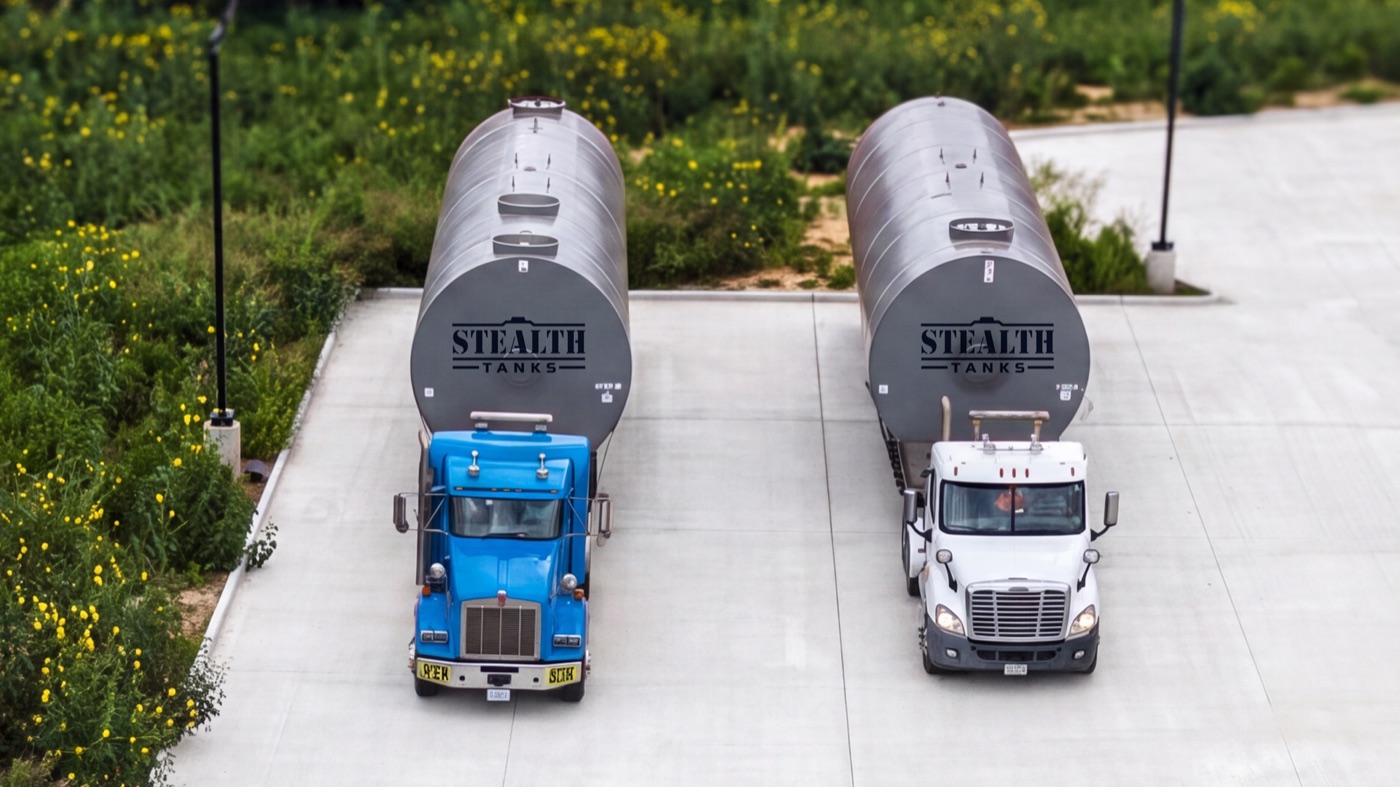
Stealth Tanks was built specifically because of this problem. We buy 32,000 and 40,000-gallon tanks from a 75-year manufacturer, stock them in our Greater Houston warehouse, and sell them with same-week shipping. No backlog, no allocation queue, no waiting for your slot to come up.
We're not cheaper than build-to-order on a per-gallon basis. We're faster. And in a market where a 2-month delay costs you $40,000–$80,000 in lost revenue on a busy station, faster is worth more than cheaper.
Current inventory: view what's in stock today →
What the wait actually costs you
Lead time gets discussed as a scheduling annoyance. On a fuel site it is a financial line item, and usually a large one. While you wait on a tank you are still carrying:
- Land and financing. Interest accrues whether or not there is a canopy on the site.
- A signed fuel supply agreement. Many brand agreements have opening-date expectations attached.
- Mobilized trades. Crews scheduled around a delivery date that moves have to be rescheduled, and rescheduling is rarely free.
- The rest of the sequence. Dispensers, canopy, and inspection all queue behind the tank. A six-month tank does not delay a project by six months in isolation — it delays everything downstream of it.
This is why comparing suppliers on tank price alone is the wrong comparison. The right one is delivered cost plus the carrying cost of the delay. We break the full picture down in what a UST costs in Texas.
Questions worth asking any supplier
- Is this tank built, or is it a production slot? The answer changes everything downstream and suppliers are not always volunteering it.
- What is the delivered price to my site? FOB-plant pricing hides a freight number that can be substantial on an oversize load.
- What has your on-time delivery looked like this year? Not the quoted lead time — the actual one.
- Can I come and look at it? If a tank genuinely exists, this is an easy yes.