Most tank conversations start with capacity, which is the wrong end. Total gallons matters, but the decision that constrains you for the life of the site is how those gallons are divided — and that comes down to which products you are selling and in what proportion.
Getting the split wrong is expensive in a specific way: you cannot fix it later without excavating a live forecourt. Capacity you can occasionally supplement with a second tank. A bad compartment split you live with.
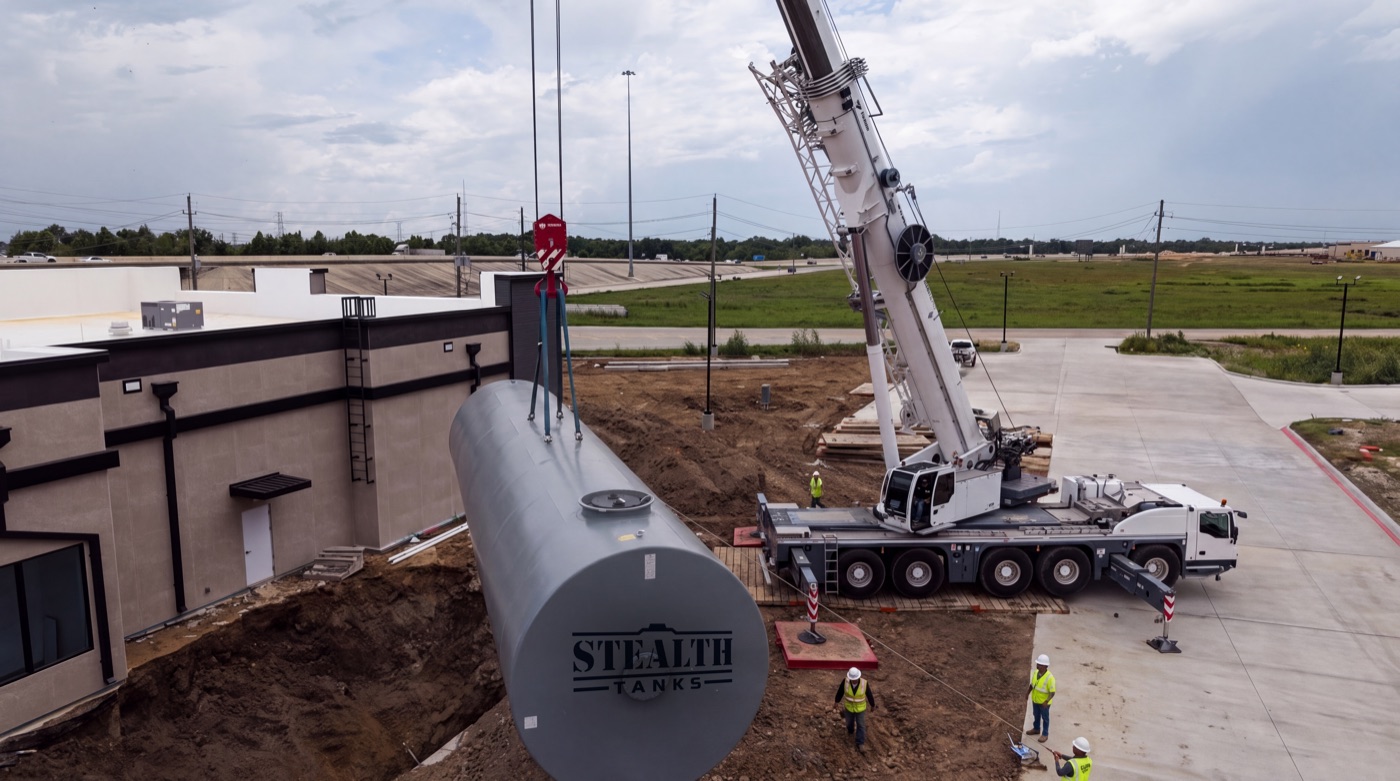
Start from the product mix, not the total
Work out, honestly, what you expect to sell:
- Three grades of gasoline plus diesel is the common full-service retail configuration.
- Two grades plus diesel where mid-grade is blended at the dispenser rather than stored, which frees up a compartment.
- Regular and diesel only on high-volume commuter or highway sites where premium turnover is weak.
- Diesel only on fleet, truck stop, and agricultural sites.
Then be realistic about the ratio. This is where operators most often mis-plan: they specify compartments in the proportion they hope to sell rather than what the location supports. A site whose traffic is 70% diesel does not need three equal gasoline compartments.
Why premium is usually the smallest compartment
Premium typically moves slowest, and slow movement is not a neutral property in a fuel tank. Gasoline degrades over time, and a compartment sized far beyond its turnover leaves product sitting long enough to matter for quality.
This is why the common retail configuration — a large centre compartment for regular with smaller compartments either side — exists. It is not arbitrary. It matches storage to turnover, so every grade cycles at a reasonable rate.
The corollary: oversizing a slow grade is a real cost, not just wasted capacity. You have paid for volume that also creates a quality management problem.
Diesel behaves differently, and the differences matter
Operators coming from a gasoline-only background are often surprised by how much more attention diesel storage needs.
Water is the central problem
Diesel holds and accumulates water more readily than gasoline, and modern low-sulfur formulations have made the issue more pronounced rather than less. Water enters through condensation, through fill points, and through worn seals, and it settles to the bottom of the tank.
That water bottom is where most diesel quality problems begin. Regular water checks and drawing off accumulated water are ordinary diesel maintenance, not an exception.
Microbial growth follows the water
The interface between water and diesel is a habitat. Microbial growth there produces sludge that plugs filters, fouls dispensers, and in the worse cases contributes to corrosion inside the tank and its fittings. Filter changes running far shorter than expected are usually the first symptom.
Practical implications when you are planning:
- Specify accessible water-monitoring capability from the start.
- Do not oversize a diesel compartment beyond its turnover — slow-moving diesel gives problems time to establish.
- Budget for filtration as an operating cost, not a one-time install item.
Cold weather is a Texas issue too
It is easy to dismiss diesel gelling in a Gulf Coast market. But Texas sees hard freezes, and sites in the Panhandle and North Texas see them regularly. Winterization is a seasonal operating question everywhere in the state, not just up north.
High-flow diesel changes the arithmetic
If you are serving trucks rather than pickups, almost every assumption shifts. High-flow dispensers move product several times faster than a standard retail nozzle, which means:
- Your diesel compartment empties much faster relative to the gasoline side. Sizing it symmetrically with the gasoline compartments will have you taking diesel deliveries constantly.
- Piping has to be sized for the flow rate, not just the product. Undersized piping starves a high-flow dispenser and the fix is not cheap once the concrete is down.
- Turnover solves the water problem that plagues slow diesel sites. Fast-moving diesel is generally healthier diesel.
- A dedicated diesel tank often makes more sense than a compartment. Once diesel is your dominant product, splitting a single tank starts working against you.
This is the case where a straight single-compartment tank paired with a compartmented gasoline tank frequently beats one large multi-compartment unit. It costs more in tank and excavation, and it usually earns it back in delivery frequency and operational simplicity.
Do not forget DEF
Diesel exhaust fluid is effectively mandatory at any site serving modern diesel vehicles, and it is easy to leave out of early planning because it is not stored in the UST.
DEF has its own requirements: it is corrosive to some common materials, it is temperature-sensitive at both ends, and it needs dedicated dispensing equipment. Plan the space and the utilities for it at design stage rather than retrofitting it into a finished forecourt.
Putting it together
A workable planning sequence:
- Estimate monthly volume by product using comparable sites in your market, not national averages.
- Decide your delivery frequency target. Weekly is common; more often costs freight, less often costs capacity.
- Size each compartment to that target, product by product, rather than dividing a round number evenly.
- Check the slowest grade. If its compartment would sit for weeks, shrink it.
- Check diesel against the dispenser type. High-flow changes the answer materially.
- Then pick the tank whose available configuration is the closest fit — and if nothing fits well, consider two tanks.
Total capacity sizing is covered in 32,000 vs 40,000 gallon, and the cost implications of adding a second tank in the UST cost guide. What we have on the ground, in both compartmented and straight configurations, is on the inventory page.
Questions about your specific project? Call us at 346-209-2032 — we give straight answers, not sales pitches.