Most conversations we have about tank removal start the same way: someone has an old underground storage tank on a site, and it has become a problem. Maybe it failed a test. Maybe the site is being redeveloped. Maybe the tank is simply old enough that replacing it has stopped being optional.
Removal is a more involved job than installation, and it carries a risk profile installation does not. With a new tank you know exactly what you are putting in the ground. With an old one, you find out what is down there as you go.
Here is how the work actually sequences, where the cost and schedule risk sits, and what to ask whoever is doing it.
Why tanks come out
The common triggers, roughly in order of how often we see them:
- Age and condition. Older single-wall tanks in particular reach a point where continued service is a bet rather than a plan. See double-wall vs single-wall for why the older construction is the one that worries people.
- A failed test or a monitoring alarm. Sometimes the tank is fine and a fitting is not, but the investigation starts the same way.
- Site redevelopment. The property is being sold or repurposed and the buyer does not want inherited underground infrastructure.
- Capacity or product change. The site needs a different configuration than it was built with — frequently more diesel, which is its own planning question.
- Permanent closure. The site is no longer selling fuel.
The trigger matters, because it determines whether you are doing a removal or a removal and a replacement — and those are scheduled very differently.
Removal vs closure in place
Not every tank has to come out of the ground. Permanent closure in place — where the tank is emptied, cleaned, and filled with an inert material rather than extracted — is a recognized option in some circumstances.
It usually comes up when extraction would undermine a structure, when the tank sits under something that cannot be disturbed, or when access genuinely does not permit a lift. It is not simply the cheaper option, and it is not a decision to make on cost grounds alone.
The consideration most operators underweight: a tank closed in place stays on the property record. It becomes a diligence item for every future sale, financing, and redevelopment. Removal ends the question. Closure in place defers it, sometimes for decades.
Whether either route is available for your specific site is a regulatory question as much as an engineering one, and it is worth settling early with your contractor and the agency rather than at mobilization.
How a removal actually sequences
1. Notification and permits
Removing a UST is a notifiable activity in Texas, the same way installing one is, and it has to be done by an appropriately credentialed contractor. There is lead time built into this, so it belongs at the front of your schedule rather than the week before the excavator arrives. TCEQ registration guide covers how notification works.
2. Emptying and cleaning
Remaining product is pumped out and either transferred or disposed of appropriately. Then the tank is cleaned — sludge, water bottoms, and residue all have to come out, and on a diesel tank that residue can be substantial. That material is regulated waste and is manifested and disposed of accordingly.
3. Making the tank safe
This is the step people outside the industry do not think about, and it is the one where cutting corners genuinely kills people. An emptied fuel tank is more dangerous than a full one, because as product is removed the vapour-to-air ratio inside moves into the explosive range.
Before anything cuts, lifts, or generates a spark near that tank, it has to be rendered vapour-free or inerted, and that condition has to be verified by measurement rather than assumed. If a contractor is casual about this step, that tells you what you need to know about the rest of their work.
4. Disconnection and excavation
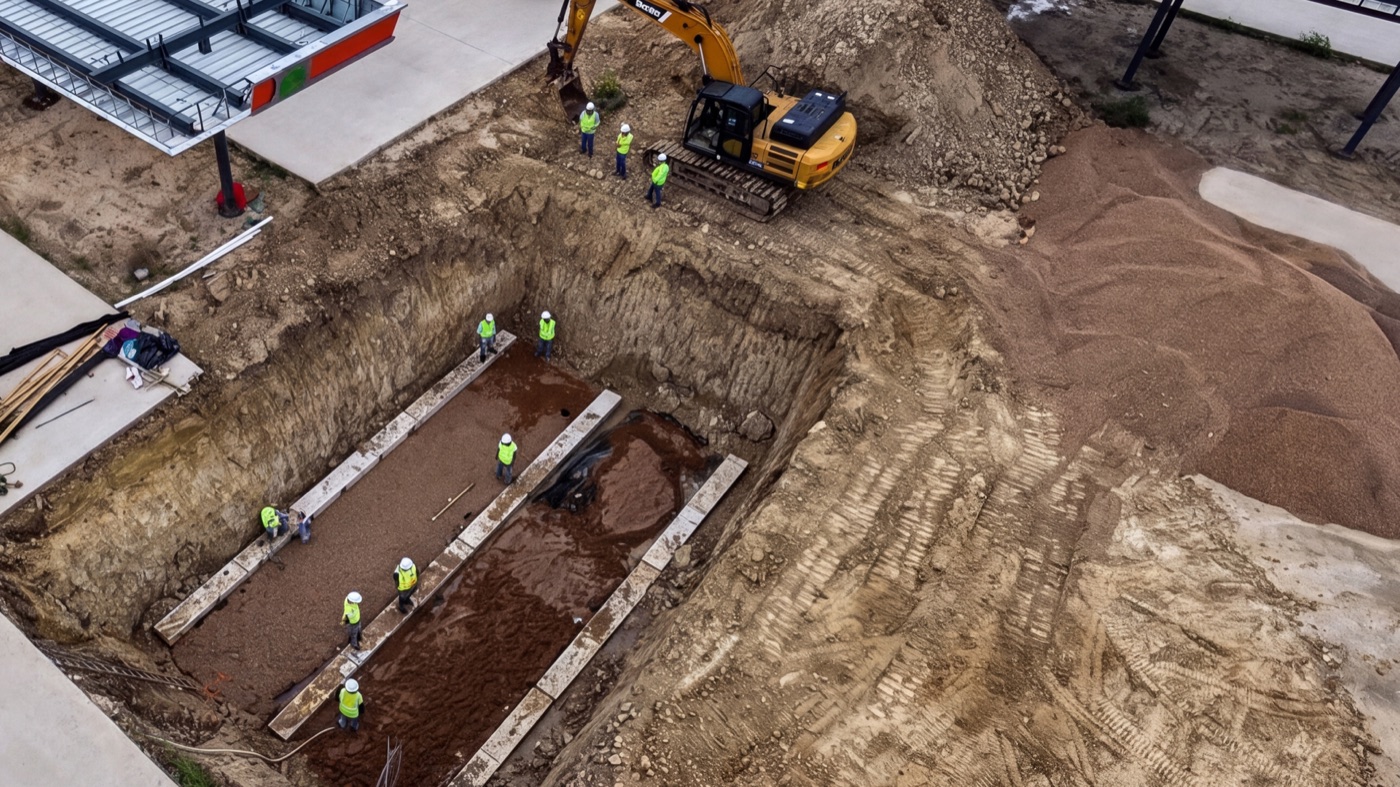
Piping, sumps, vents, and fill points are disconnected and removed. Then the excavation opens the tank field — which on a live site means working around whatever is still operating, and on a Gulf Coast site frequently means dewatering.
5. Extraction
The lift itself is usually the fastest part of the whole job. It is also where old tanks get damaged, which matters if anyone downstream intends to reuse them — a consideration we cover in new vs used underground storage tanks.
6. Assessment of the hole
With the tank out, the excavation is inspected and soil samples are taken to establish whether there has been a release. This is the moment the project either continues as planned or becomes something else entirely.
7. Disposal
The tank is transported and disposed of through licensed channels, with documentation. Keep that documentation — it is part of the site record.
8. Backfill, or the next tank
If nothing is going back in, the excavation is backfilled and the surface restored. If a new tank is going in, you are already at the point where the installation would have started anyway — which is the whole argument for doing both at once.
The part that actually decides the cost
Removal quotes vary far more than installation quotes, and almost all of the variance comes from one question: is the soil clean?
If sampling comes back clean, a removal is a predictable job. If it does not, you are no longer running a removal — you are running an environmental project, with its own investigation, its own regulatory track, its own timeline, and a cost that is not bounded by anything in your original quote.
This is why we tell people not to treat a removal quote as a fixed price for the outcome. It is a fixed price for the work, contingent on what the excavation finds. Anyone quoting a firm all-in number before the tank is out and the soil is sampled is either carrying an enormous contingency or is going to have a conversation with you later.
Practical guidance:
- Assume a release is possible on any older single-wall installation, and carry a contingency accordingly.
- Do a Phase I before you buy a property with tanks on it. The cost of that assessment is trivial against what it can find.
- Do not let schedule pressure push you into skipping the assessment step. Discovering a release after the concrete is poured is the worst version of this.
- Know who your environmental consultant is before you need one, not after.
Doing removal and replacement together
If the old tank is coming out and a new one is going in, doing them as one job rather than two is almost always the better call:
- One mobilization. Crew, equipment, and crane show up once.
- One excavation. This is the big one. The hole is a substantial share of the cost on both jobs, and digging it twice is pure waste. Our UST cost guide shows how much of the total the excavation actually represents.
- One period of disruption. On a trading site, closure time is revenue, and two separate closures cost more than one longer one.
- One party accountable. When removal and installation are separate contracts, the seam between them is where problems live — particularly if the assessment turns something up.
The constraint that usually breaks this is tank availability. If the replacement tank is four to six months out, you cannot sequence them together without leaving an open hole or a closed site for that period — so the removal happens now, the installation happens later, and you pay for both mobilizations.
That constraint disappears if the replacement is already built. We hold new USTs in stock precisely so removal and replacement can be scheduled as one continuous piece of work; current availability is on the inventory page, and the underlying supply problem is covered in why UST lead times hit six months.
What to ask a removal contractor
- Are you registered to do this work, and is that registration current? Verify it rather than taking it on trust.
- How do you make the tank vapour-free, and how do you verify it? You want a specific answer involving measurement.
- What is in the quote, and what is explicitly not? Establish where the removal scope ends and an environmental scope would begin.
- Who does the soil sampling, and when do I get results?
- What happens the day sampling comes back dirty? Ask before you sign, not after.
- What documentation do I receive? Closure records, waste manifests, disposal documentation, and sampling results all belong in your site file.
- Can you handle the replacement too, and do you have the tank? If the answer to the second half is no, the two jobs will be separated whether you wanted that or not.
Where we fit
We remove and decommission old underground storage tanks, including closure documentation, soil sampling to check for contamination, and licensed disposal of the tank. We most often do it as a single mobilization with the replacement installation, because we have the new tank on the ground and can schedule the two continuously.
If sampling finds a release, that becomes a specialist environmental scope — a separate track from the tank work, and one you want the right people on. We will tell you plainly when you are in that territory rather than working around it.
More on the full range on the services page, or see underground storage tanks in Houston for delivery and installation coverage across the region.
Questions about your specific project? Call us at 346-209-2032 — we give straight answers, not sales pitches.